
“Trust us. And when we're behind — trust us even more.”
A counterintuitive approach to managing expectations, delivering quality work and building trust
by Anton ZemlyanoyCan you imagine asking this of your team? Or your boss? Or your client? To tell your stakeholders, investors or sponsors in advance: when we're running behind — trust us even more to do the job you've invited us to do?
Well, this was a real request made by Valerie¹, one of the team leaders I was working with on a group project. This is also what Jeff Bezos, in his own way, said to his shareholders in 1997, but I’ll get to that later.
Back to Valerie’s request. We were on a preparatory call for a project that was about to go live, discussing how we should work together, and she asked something I didn't expect: that the rest of the team not stress if the leaders fall behind the official schedule.
When I asked them what we could do to support them well, she replied:
“Trust us. And when we’re behind — trust us even more.”
I remember to this day how surprised I was to hear it. And even more, how it felt to act on it — to feel the tension build in me as we fell behind — and to remember that I'd agreed to honour this request. That agreement became my anchor. It helped me step back, not go into a reactive mindset, and watch what happens.
When the project finished, I reflected on Valerie's ask and realised I had made very similar requests throughout my career — of my teams and clients, whenever we were behind in important projects. Especially when clients would start to get anxious and ask us to hurry up — when a well-intended but worried thought would override what they already knew: that slowing down now to find the right combination would let us speed up later — and deliver a much better product.
I always asked them to trust us because I knew my team got paid to produce quality work, not just to ship it on time. But I always made that request after we were already behind. Valerie asked for it in advance and that was the difference.
Why requesting trust in advance is a powerful way to manage expectations
Requesting trust before a project begins does something powerful: it normalises that progress doesn't always follow a pre-set schedule, and it removes the unpleasant surprise for the other party. It is often when we are unpleasantly surprised that we are most likely to react rather than respond.
It sends a message:
Delays are normal. If, and when, we encounter them — know that it is part of the process. That we are aware of time, and that we are consciously choosing to go slower at this stage, because it will enable us to go faster later.
It reminds stakeholders that time variability is a natural part of any process where humans are involved. But we often forget this — especially when we let the pressure get to us.
Jeff Bezos did something similar in his first letter to Amazon shareholders² in 1997. He didn't ask for trust when things got tough. He set expectations upfront: Amazon would make investment decisions based on long-term market leadership, not short-term profitability or Wall Street reactions. Some bold bets would pay off, others wouldn't.
And then he added:
“We aren't so bold as to claim that the above is the 'right' investment philosophy, but it's ours, and we would be remiss if we weren't clear in the approach we have taken and will continue to take.”
In other words: this is how we operate — and if that tension is too much for you, we may not be the right investment. He attached that letter to every annual report that followed.
What micromanagement actually costs your team
Valerie's request did something else: it invited the team to trust even more at the exact moment when a first reaction might be to step in and take control. Or the lighter version of control — to advise.
This matters because when the person running late doesn't feel overly pressured, they stay in the space where quality work actually gets done.
One of the most frequent challenges I see in new managers and executives is that they collapse into taking over — completing tasks themselves, closely monitoring the project — which leads to working extra long hours at the cost of sleep, exercise, time with friends and family. That pattern breeds resentment — towards themselves and their teams. Their self-talk starts to sound like Why do I have to keep doing everything myself?
And then comes what I call the trust erosion spiral: trust less, control more, feel more stressed, feel like you can't trust others — and the cycle continues. Each turn through the loop makes the next one harder to break.
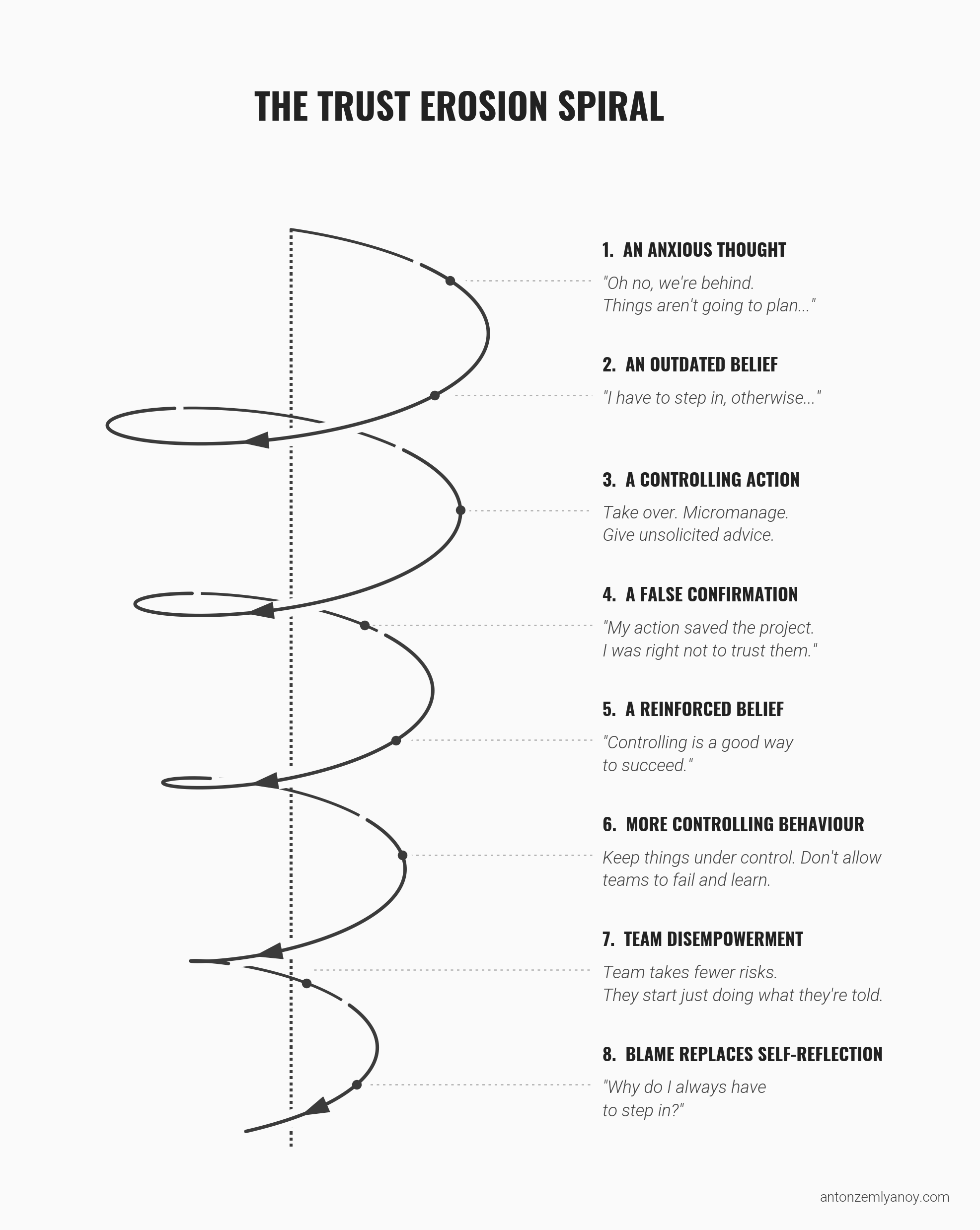
The good news is that you can pause and choose to act differently at any point in this spiral — I’ve seen enough people reverse this spiral and gradually undo the damage they caused.
I know, trusting even more can be scary because we all have promises to keep. But when our stepping in is fuelled by worry rather than seeing the bigger picture, it comes at high costs: the cost of autonomy and self-esteem to others. The cost of reduced morale and reduced engagement. And somewhat ironically, it robs team members of being able to recover themselves — hindering their growth and leaving the “saviours” stuck in the loop.
Choosing to trust, to see what happens, and to learn from it for better collaboration — that not only frees up your time to focus on your job as a leader, but also sets up a healthy culture of experimentation and honest feedback, resulting in stronger engagement and better performance long-term.
Why trust matters: the numbers
In a global survey³ of over 15,000 professionals, 80% said they would stay in a job if they had a manager they trust. In an era marked by layoffs, return-to-office mandates, and workplace surveillance, having a manager in your corner matters more than ever.
80% of professionals say they would stay in a job because they have a manager they trust.
One leader I work with puts it this way: “I prefer to advance trust.” She trusts first — without proof — and adjusts as needed based on performance. Not blind trust. Intentional trust. The kind that says, “I believe you can deliver, and I'll course-correct if the evidence tells me otherwise.”
This is the opposite of the default many leaders operate from, where trust has to be earned before it's given. Advancing trust doesn't mean ignoring red flags. It means starting from a position of belief rather than suspicion.
Letting go of control is a leadership skill — and it requires negative capability
Trusting is a choice. A choice you can practise making. For people for whom not taking over is new, it will take practice. Practice that initially will feel uncomfortable. But if you want to develop this skill, your job will be not to act on that discomfort right away.
There is a name for this: negative capability — the ability to choose not to act. To sit with uncertainty, with tension, with the discomfort of not knowing how things will turn out — and to not rush in with a fix. It was the poet John Keats who first used the term, describing the capacity to remain "in uncertainties, mysteries, doubts, without any irritable reaching after fact and reason."⁴ It turns out this is not just a poetic ideal — it is one of the most practical leadership skills you can develop. It's what separates leaders who micro-manage from those who develop other leaders.
Because the impulse to step in is rarely about the task — it's about relieving your own discomfort. Negative capability is the practice of noticing that impulse — and choosing not to follow it.
Like your ability to let a child fall as they're learning to walk, although at first it feels emotionally wrong. The same principle, adjusted to the adult context, applies to teams and trusting others.
Practising trusting others when the outdated alarm bells are ringing inside your head and you’re imagining worst-case scenarios. Practising paying attention to those imagined scenarios and asking yourself: What if they aren't true?
And with enough practice, it will get easier.
So, here is my invitation:
Find where you can practice trusting people more when they are behind or not doing things your way. And ask them how it felt for them to experience this from you.
It could be your partner setting the dinner table. It could be your newly promoted team member. It could be your kid working on something. It could be you — not getting it right and starting the loop of negative self-talk. Practice the art of trusting and observing the impact. And as usual: adjust as needed, but maybe not right away, because change requires time.
Read next
Footnotes
The leader to make this request was Valérie Overmeer while working along with Alex Velrek.
Korn Ferry. (2025). Workforce 2025: Power Shifts. Global survey of 15,000+ professionals across 10 markets.
Bezos, J. P. (1997). Letter to shareholders. Amazon.com, Inc.
John Keats, letter to George and Tom Keats, 21 December 1817.
About the author
Anton Zemlyanoy is an executive coach who helps leaders navigate change with clarity and self-trust, turning self-talk into a leadership strength.
Want to explore this for yourself or your leaders?