
What to Do When Things Aren’t Working Out
How to navigate the lows of any ambitious project, idea or career
by Anton Zemlyanoy | Self-TalkSome things aren’t going to go your way. Actually, a lot of things aren’t.
Any career, ideas or projects that involve ambition come with cycles: periods of momentum and recognition, followed by setbacks, stalled progress, and dips in confidence that can feel disorienting and personal.
These lows are unavoidable. What is optional is how much they cost you.
The quicker you learn how to recover from emotional dips and get yourself back on track, the less energy you’ll waste fighting reality — and the more capacity you retain to keep moving forward.
Like in surfing: when a wave is about to crash on you, having strategies to dive under it — or recover quickly after — makes the difference between continuing to move forward and being dragged under the surface, burning energy and needing much longer to recover. Trust me, I know how it feels to burn energy while being dragged under, which is why I had to learn how to recover — and now writing about it.
This article explores such strategies that help shorten those low periods and build resilience over the long run.
1. Accept: low periods will happen
Periods when things aren’t working out are not a sign that something has gone wrong and you’re on the wrong path. Just do some research and learn that this is more of a norm than an exception. Projects often don’t take off for a while. Momentum stalls. Confidence dips. Sometimes repeatedly.
What makes these periods harder than they need to be is not the setback itself, but the expectation that it shouldn’t be happening.
“It's not that I'm so smart, it's just that I stay with problems longer.”
- attributed to Albert Einstein
The moment you frame a dip as abnormal, you start spending energy asking often unhelpful questions:
Why is this happening again?
What does this say about me?
About my idea?
Am I made out for this?
Did I/we make the right choice?
In such low periods, self-talk is likely to be coloured by doubt and be negative, disempowering, and not your best resource, as it will be skewed towards why you shouldn’t continue.
That self-talk drains you faster than the setback ever could. Acceptance doesn’t mean liking the situation. It means recognising it for what it is — a phase, not a verdict. And that recognition frees up energy for recovery.
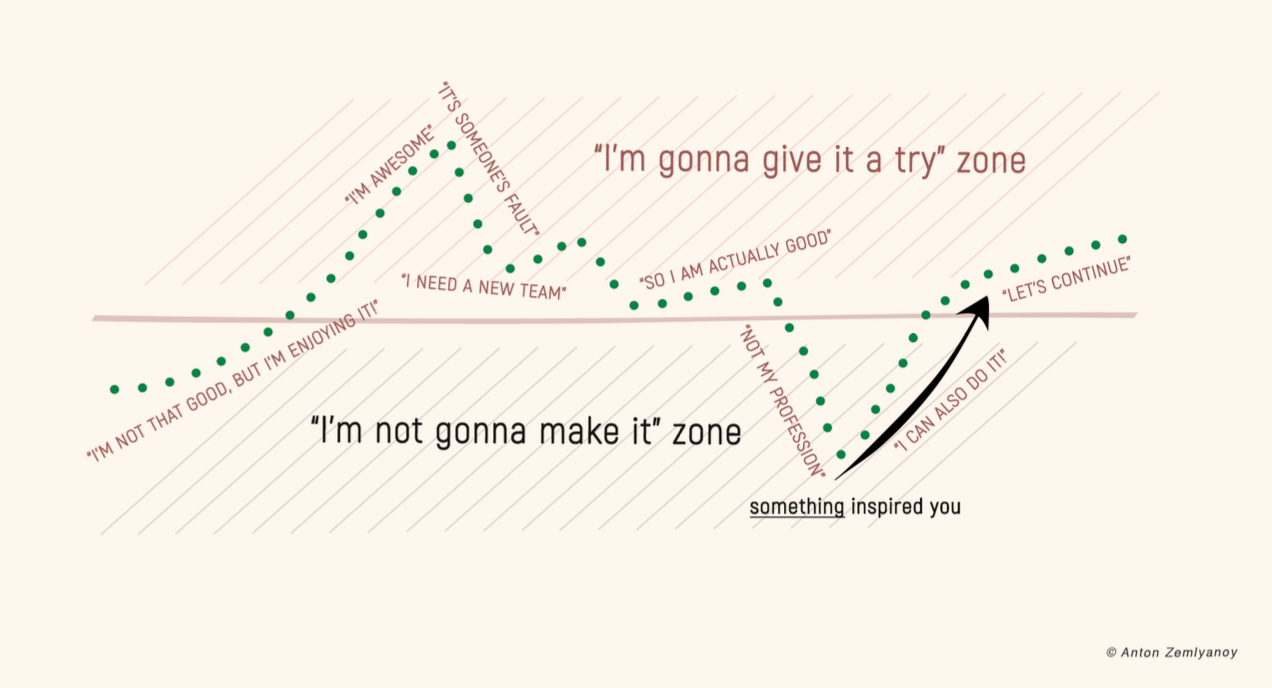
2. Find your own ways to recover from the ‘I’m not gonna make it’ zone
Resilient people aren’t better at avoiding lows. They’re better at recovering.
They know — often through experience — what helps them come back to resourcefulness when confidence drops and perspective narrows. And they don’t wait until they’re completely depleted to use those strategies.
These recovery strategies are personal, but they tend to fall into a few broad categories.
Learn how to work with your inner critic
Inner critic is a metaphor to describe negative self-talk, when instead of learning from your mistakes, you start to beat yourself down and put yourself into a negative spiral, making incorrect judgments and assumptions about your overall capabilities. I’ve seen this happen to people in many professions, from creative freelancers, to doctors, to heads of hospitals, business owners and executive-level leaders. Learning how to work with an inner critic is an essential skill if you want to achieve both external and internal success.
If you notice this in yourself, you can start by reading Introduction to Inner Critics. Make sure you also grab my free Inner Critic worksheet so that you can start working on making a change, and not just reading about it.
Use rest and energy as power sources
You need energy to keep going. And yet this is the first thing many people neglect when things aren’t working out.
Sleep, quality nutrition, and physical movement are not “nice to have” extras. They are the foundation that makes everything else possible. When your body moves, it processes stress — taking pressure off your mind to do all the heavy lifting on its own.
A reminder worth keeping close: never make important decisions when tired.
Fatigue has a way of turning temporary problems into permanent-sounding stories.
Find the right kind of inspiration — for you
Not all inspiration helps when you’re low.
For some people, myself including, it’s listening to others who speak honestly about long arcs, not shortcuts. For others, it’s spending time with like-minded people who are also working hard on what’s important for them. Sometimes it’s a walk, solitude, music, or reading something that widens perspective without demanding immediate action.
The key is knowing what reliably helps you lift, rather than reaching for random motivation. Which means that you’ll need to experiment until you find what works for you. Inspiration isn’t gonna keep you going forever, but it can act as a spark plug to get you in the ‘I’m gonna stick with the problem for longer’ zone.
Here is another reminder: never make important decisions when disappointed.
Disappointment narrows perspective. It shrinks visible options. But the right kind of inspiration opens you up to possible ways through.
Try action as recovery and a way through
Sometimes rest helps first. Sometimes taking action helps differently.
At certain times, clarity and motivation don’t arrive before action — they emerge through it. A small, meaningful step can shift the internal conversation from “Why did I sign up for this?” to “I’m figuring this out, one step at a time.” This is because we can be rested and still stuck in a disempowering perspective, and the goal here is to shift your perspective, your self-talk, via actions that create evidence you can’t argue with.
The goal isn’t productivity. It’s regaining a sense of agency: that yes, you can do something to keep going.
3. Ask others to remind you when to take a pit stop
This part is often underestimated.
When you’re in a low place, your access to your own wisdom shrinks. You forget what helps. You isolate. You keep pushing, although you’re driving on flat tires. You delay doing the very things that would make recovery easier. You don’t go into a pit stop. And we all know where that can lead — not only for you, but even for the world’s best Formula 1 drivers.
That’s why it is very wise to outsource remembering, which is what I’ve seen resilient people do.
They have one or two people they trust — people who know what their recovery strategies look like — and who are allowed to remind them, sometimes firmly, to change their state. To sometimes say: “This looks like one of those moments. Do the thing that helps you recover.”
In my own life, my partner and I have, over time, created agreements where she can say to me “You’re not a pleasure to be around at the moment, go read a book or go for a surf.” That usually jolts me. And I can say to her “Go exercise, we all need you with better energy”. This works for her.
That reminder, an agreed push, can be the difference between a short dip and a longer spiral.
Life is a marathon — and sometimes a roller coaster
I really like the saying "Life is a marathon, not a sprint". It seems to be applicable to any career path. But I’ve also seen that it can be a roller coaster.
Accept that the lows will happen. Prepare your own ways back. Let others help you remember when you forget. And you will make it easier for yourself, and for those around you, to stay with the challenge long enough to solve it.
I will leave you with one of my favourite poems from Bruce Lee that did its fair share of inspiring me:
The doubters said,
"Man can not fly,"
The doers said,
"Maybe, but we'll try,"
And finally soared
In the morning glow
While non-believers
Watched from below.
P.S. If you’re in a particularly deep low after a major hit, read How to recover after a metaphoric car crash, where I explore recovery after bigger collapses in more detail.
Read next
Read more from the Self-Talk seriesFootnotes:
For a great read on going through the lows in entrepreneurship and startups, see “The Messy Middle” book by Scott Belsky.
About the author
Anton Zemlyanoy is an executive coach who helps leaders navigate change with clarity and self-trust, turning self-talk into a leadership strength.
Want to explore this for yourself or your leaders?