
Your Internal Operating System Has a Maturity Level
Here’s how to upgrade it
by Anton Zemlyanoy | Self-TalkHave you ever wondered why one person can be grateful for the critique of their work, while another one gets triggered? Why one person thinks They are right, my proposed strategy can be stronger, while another’s inner dialogue sounds like They probably don’t trust me or I knew I wasn’t made out for this role, and has their confidence shaken for weeks, or even years? Or why some people are great at working in teams, while others excel individually and are better left off that way?
The difference isn’t necessarily in personality. It’s where you are on a maturity continuum — and your inner dialogue reflects this.
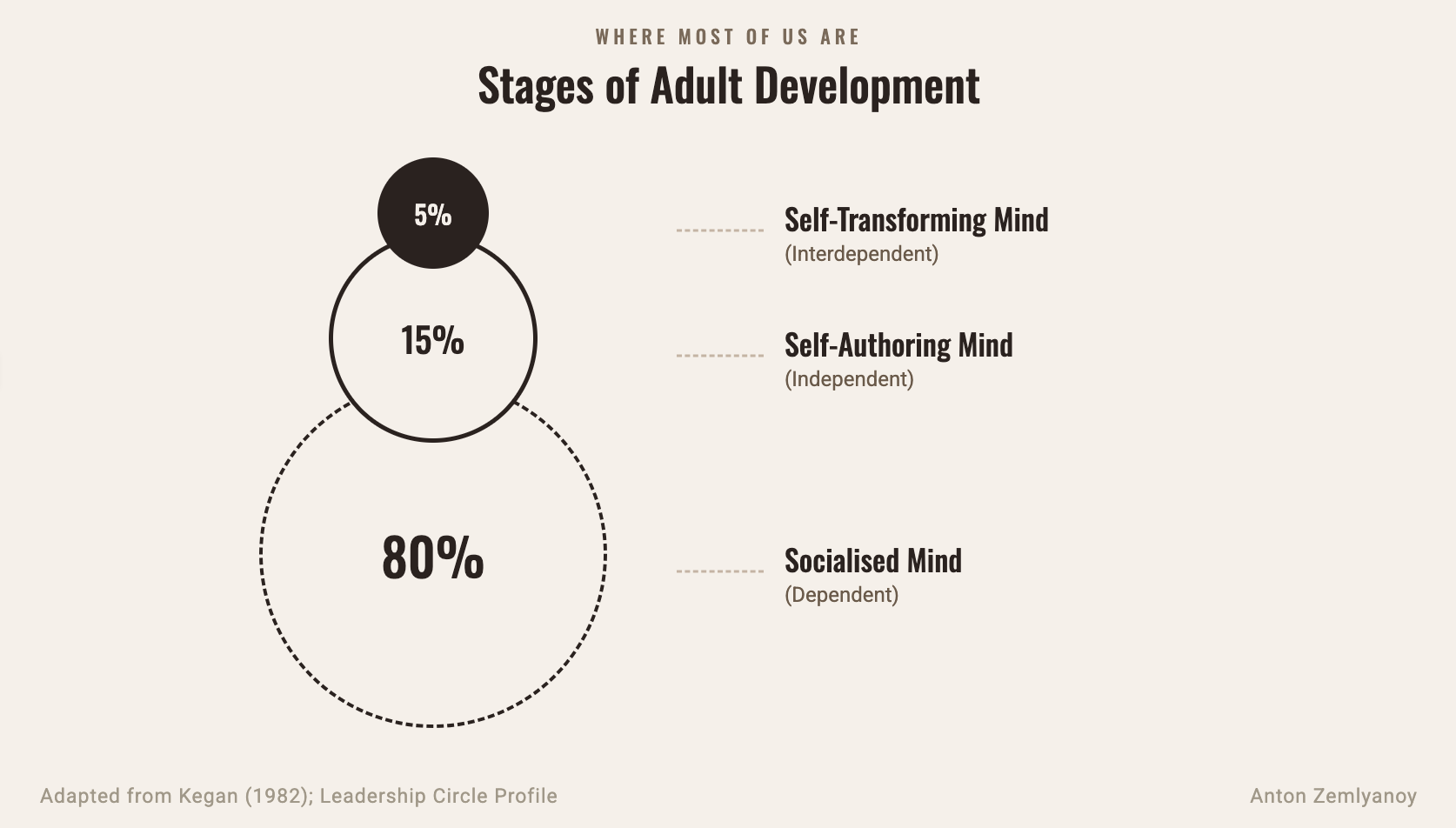
In 1989, Steven R. Covey¹ wrote about the Maturity Continuum, which has also been studied and described in detail in a field called adult development². What he and many others have found is that people operate from different stages of development, or maturity, in adult life. These stages are a cluster of beliefs and capabilities and serve as a foundation from which we work and relate to each other. They inform how we function, what we're capable of doing, where we collapse and why, and he divided them into three stages, or what he calls paradigms: dependent, independent and interdependent.
In short, people operating from the dependent paradigm are affected by the opinions of others at the cost of their own; independent — have a stronger foundation of self and can hear feedback, but are likely to dismiss it and still find it challenging to work with others because they are too focused on their own independent thinking; at interdependent — this is the most advanced paradigm — the person is equipped emotionally and cognitively to deal with more intricate nuances of relating to, and working with, others. Think of it as three different internal operating systems, each robust for specific tasks, with the more mature ones being built upon the previous.
In my work, I noticed that our inner dialogue, or our thinking if given a voice, is both an indicator of where we are on this continuum and a doorway through which we can mature.
Self-talk: our thoughts and beliefs placed into a conversational form that can be observed.
Our self-talk is both an indicator of our maturity and a doorway through which we can develop.
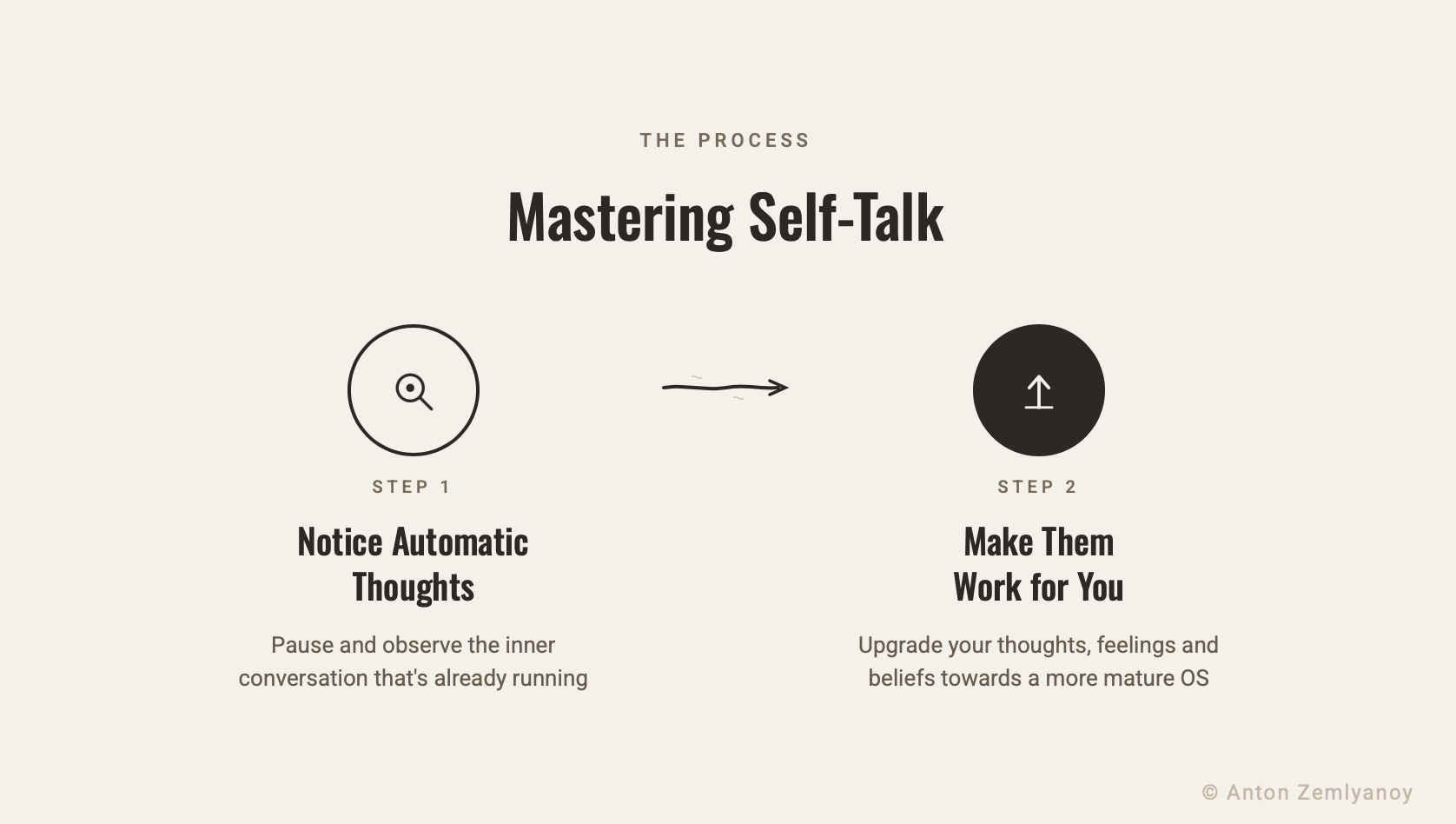
That is because we are meaning-making creatures. How we think and what meaning we assign to situations forms the foundation of the internal operating system we think from. However, we make these meanings at high speeds — approximately 6,200 distinct thoughts a day³ — and when our thinking is habitual, it can run on autopilot and we don't even recognise it. That is until we pause and pay attention to it. Once we notice our thoughts, we can then see what they are and how we talk to ourselves about events in our lives. Being aware of our thoughts is a must in what I call mastering self-talk: the process of making our automatic thoughts conscious at first, and then making them work for us second. It involves learning how to upgrade our thoughts, our feelings and our beliefs towards a more mature internal operating system.
So, when you ask yourself what do I think, how do I feel, or what do I believe about the current situation? — you are shining light on potentially automatic thoughts and proactively entering these conversations, like a movie editor teaming up with a script writer.
Mastering self-talk = noticing automatic thoughts → making them work in your favour.
The dependent operating system: when other people's opinions run your life
The self-talk at this internal operating system (OS) revolves around What will they think if I do X? A dependent OS relies on others too much at the cost of relying on oneself. It depends on the opinions, approvals and validations of others a lot more than their own. Or as Mel Robbins describes this brilliantly and bluntly in her book The Let Them Theory⁴, you give away your power to others. That is because every decision you make — you filter through the potential opinions of people around you too much and not enough through what you think is the right thing to do. You're depending on others too much and not enough on yourself.
If you're in an intimate relationship, you will be depending on your partner to confirm that you're beautiful, intelligent, interesting, wanted etc. At work, you will be seeking your boss's approval and struggling when it doesn't come in as often as you want it. You will be seeking their input not as a way of aligning and synergising, but as a way to confirm your choices, because you don't trust yourself enough. You will be saying yes to all client or manager's or investor's requests because you're afraid of upsetting them. I've seen such otherwise very intelligent leaders operating from this OS bring whole teams and organisations into high turnover and burnout.
When things aren't working out, a person functioning from a dependent OS will blame others for results in their life: someone else caused the project to fail; they trigger me; I had no choice, but to let them go. Although it's easy to associate dependence with something undesirable, there are many areas of our life where we can be dependent, while also being independent in others. For example, I am completely dependent when it comes to yoga: I am terrible at trying to do a 30-minute session on my own. But I am great at putting a yoga video on and following the instructions: not only it allows my mind to rest (I don't have to decide, I just follow). I fully accept my dependence on an instructor to be a good yoga practitioner. You could be a good dependent team player, as long as your team members, boss and clients are nice to you and don't challenge you too much. An important nuance to note: if I don't enjoy the yoga class, I don't blame the instructor, I admit that I took a chance and perhaps didn't research my choice beforehand — I take my share of responsibility for how I feel, which is more of an independent way of operating.
And if you're like me, you can probably remember yourself operating from this dependent OS. It doesn't mean you only operate from here and that is because our psyche is dynamic, rather than static. Meaning that we can temporarily regress under pressure. I've seen people temporarily move down a stage if experiencing too much pressure or uncertainty: a usually trusting manager can't handle the pressure of deadlines and starts to micro-manage her team's work; a recognised leader puts together a great team and starts to worry that a team member is smarter than her (rather than thinking how to utilise her team's talents). Or, as one of my teachers said, "I am very good at this… on a good day".
The independent operating system: strong self-reliance and its hidden ceiling
Independence is an internal operating system of strong reliance on self. The self-talk here sounds like: I can do it. I am responsible. I am enough. I will figure this out. I will ask for help if I need it. I am triggered. I am choosing to let a person go. If you ever heard the saying "Take 100% responsibility for your life"⁵, it comes exclusively from this OS. Mel Robbins, in The Let Them Theory⁴, repeatedly calls people into this independent OS, to drop the shackles of dependence on other people's choices. When I naively tell my partner that I don't like a certain 'very fashionable' jacket on her, she responds with "Of course you don't, that's because you don't have any fashion sense!" This is a grounded, with a perfect dose of humour and provocation, independent response.
At an independent OS, you can organise and manage yourself, you know the value you bring, you know you are capable. You also know your limits and peculiarities and how to manage around them.
But listen for the shadow side of this voice. If you only run the independent OS (and not stepping into an interdependent one), you are likely to dismiss the opinions of others and keep pushing your point of view, often discarding their input because you are not able yet to integrate them into a solution. Think of a CEO who collects feedback for a strategy, but dismisses it and does it her own way. Self-talk here often sounds like Why aren't they smart enough. How can I trust them? I can do it quicker myself. Or, They are smarter than me, how can I be their leader? Why don't they listen to me?
This is why some high-performing individuals often struggle when promoted to managerial or leadership roles. Or executives find working with stakeholders exhausting. Having learned how to be responsible for themselves, they realise that systems and rules that worked for them as individuals don't automatically translate to their teams and stakeholders. Micro-management, team burnouts, high turnovers, criticism and unhealthy perfectionism, are often signs that your independent OS has not yet been upgraded to an interdependent one.
The interdependent operating system: how mature leaders think with others
Interdependence is a more mature internal operating system than the two before it. It has the foundation of the previous two, but with an additional layer of nuance, tolerance and capabilities. Self-talk here sounds like: What are they seeing that I'm not? How can their strong opinions improve my strategy? From interdependence, you are able to not only be responsible for yourself and your work, but also collaborate with others to create something better, or simply different, than you could on your own.
Think of the famous scene from The Wolf of Wall Street where Matthew McConaughey starts to thump his chest and hum a ridiculous tune to Leonardo DiCaprio's surprise. McConaughey had been doing this as a vocal warm-up between takes. It was DiCaprio who noticed and suggested he do it in the actual scene. Scorsese loved the idea and integrated it into the film.⁶ What makes this an interdependent moment: neither DiCaprio nor Scorsese felt threatened by something unscripted. DiCaprio saw value in another actor's quirk and brought it forward; Scorsese trusted his actors enough to let the scene evolve beyond his own vision. A person running an interdependent OS not only welcomes different perspectives, but seeks them out intentionally.
People with a strong independent OS are usually great individual contributors (golf players, writers, singers, programmers, solo technical leads, analysts, doctors, lawyers), but not great leaders or team players, both of which require us to function interdependently. And while there are other ways to explain why we may prefer solo work over teamwork (see Susan Cain's book Quiet⁷), the maturity spectrum is not about our preferences, but about our abilities to function and relate at different levels.
Why you can't skip a developmental stage
Interestingly, Covey writes that you cannot skip a stage and jump from dependent to interdependent¹. That only independent people can become interdependent, because dependent people don't have enough maturity to become interdependent — they don't "own enough of themselves" and therefore, lack the foundation, to be challenged, pushed back, and not collapse into either-or, me-vs-them thinking, when experiencing friction, which is an inevitable part of any relationship and a creative endeavour.

Before you get too hard on yourself, I want to put things into perspective: most of the adult population in the modern world works and functions between dependent and interdependent operating systems, or as Kegan and Lahey call them, socialised and self-authored². And we still are able to somehow get along, and to collaborate. But it is harder from a dependent OS.
Why self-talk is both a mirror and a doorway to maturity
I wrote earlier that self-talk is both a reflection of where we are on this maturity continuum, and a doorway through which we can mature, which is why I pay so much attention to it in my practice. The main message I want you to hear is this: you can strengthen your foundation and accelerate your growth towards the more advanced operating systems via intentional practice, specifically in updating your beliefs.
In fact, I find that most of the work that therapists, psychologists and coaches perform comes down to basically this — helping people shift towards a more advanced internal OS: therapists help people strengthen their sense of self towards independence and ownership; Mel Robbins's main message in both The 5 Second Rule⁸ and The Let Them Theory⁴ is about strengthening your independent OS. James Clear's writing in Atomic Habits⁹ on habits, systems, sticking to your goals and organising yourself also aims to strengthen your independent OS. Steven Covey's The 7 Habits of Highly Effective People¹ covers both independent and interdependent paradigms in what he calls private victory first (independent), and public victory second (interdependent). Esther Perel, in her incredible podcast Where Should We Begin¹⁰ mainly focuses on developing interdependent ways of being in relationships with others.
How to upgrade your internal operating system through upgrading your beliefs
The shift from one operating system to the next isn't about reading the right book or having a single insight. It's about practising a different inner conversation — consistently — until it becomes the natural one.
From dependent to independent: strengthen the “I”
This is where your job is to strengthen your ego. Strengthen your I. Strengthen your relationship with yourself, so that you trust yourself. The self-talk shift sounds like moving from What will they think? to What do I think?
Find supportive people, teams, bosses, mentors, teachers. They will help you to trust your vision more and in turn — strengthen your independent foundation.
If you notice yourself thinking I can't do this without their approval — pause. Ask instead: What would I choose if no one was watching? You don't need to act on it immediately. Just hearing your own answer begins the shift.
Here are more examples of what this shift sounds like in practice:
| Dependent | Independent |
|---|---|
| They didn't like my idea. I must be wrong. | They didn't like my idea. That doesn't mean it's wrong — it means I need to think about it further, or present it differently. |
| I need my manager to tell me this is good enough. | I believe this is good enough. I'll share it and stay open to feedback. |
| I had no choice but to agree. | I chose to agree — and next time, I want to choose more deliberately. |
| They trigger me. | I am triggered. What's happening inside me? |
by Anton Zemlyanoy
The work is simple and hard at the same time, like practising yoga or public speaking. You need to practise it enough times until it becomes a natural part of your identity, of how you live, with a stronger centre of self-trust.
From independent to interdependent: strengthen the “We”
The self-talk shift here sounds like moving from I've got this to What are we capable of together? This is where you strengthen your ability to collaborate with others. Strengthen your trust in others, in their input. Trust in yourself that you can integrate their input to either strengthen yours, or come up with a new and better version of whatever you're working on.
As Covey writes, think win/win and actually practise looking for win/wins for both parties¹. The answers won't come right away, but they are worth it.
If you notice yourself thinking Why can't they just do it my way? — pause. Ask instead: What are they seeing that I'm not? That question is the sound of interdependence beginning.
Here are more examples of what this shift sounds like:
| Independent | Interdependent |
|---|---|
| I can do it quicker myself. | I can do it quicker alone — but what could we build together that I can't build alone? |
| They are smarter than me, how can I lead them? | They are smarter than me in their domain — that's exactly why I chose them. My job is to direct our combined strengths. |
| Their feedback threatens my vision. | Their feedback is data. How does it strengthen what I'm building? |
| I don't need their input. | I don't need their input to survive. But I might need it to create something better. |
by Anton Zemlyanoy
A general principle to remember
A great way to shift to the next stage of maturity is to absorb the thinking of people at the later stage. This is why asking others what they think can be so useful — and you can hear back: "Oh, not a big deal, people will disagree with you all the time, it's part of the job." That response, from someone running a more mature OS, plants a maturity seed in yours.
Here is what this looked like in practice. Samantha, a high-performing country lead, said in a session that she wanted to discuss her freezing up in a recent board meeting. We realised that the boardroom reminded her of an interrogation setting — she was seeing presenting to the board from the perspective of I'm being interrogated, they're trying to catch me out.
So we worked on shifting her perspective: Perhaps they are asking me to present because I am an expert in my field and they need my input to make better decisions. A seemingly simple, yet powerful, shift. Two weeks later, Samantha was smiling as she shared that not only did she manage to not freeze and present her whole piece, but that she even enjoyed herself (a bit).
What happened? Samantha absorbed a more mature way of thinking about her situation — one that didn't depend on others' approval (they're judging me) but instead trusted her own value (I'm here because I know this). Her self-talk shifted from a dependent OS to an independent one, with a touch of interdependence (they want my opinion to make informed decisions), and her behaviour followed.
Closing
Every client I've worked with who has shifted from one operating system to the next did it the same way: they noticed a thought, questioned it, and chose a different one. Not once — hundreds of times. Until the new thought became the natural one. Self-talk is both a mirror and a doorway. The mirror is always available, if you're willing to look at it. The doorway is there if you choose to practise. If you want to make things easier for you — there is plenty you can do.
Read next
Footnotes:
Covey, S. R. (1989). The 7 Habits of Highly Effective People. Free Press/Simon & Schuster. The Maturity Continuum is introduced in Part Two. "You cannot skip stages" is in the paradigm overview (pp. 49–52). Win/Win is Habit 4 (Part Three: Public Victory).
Kegan, R. (1982). The Evolving Self. Harvard University Press; Kegan, R. & Lahey, L. L. (2009). Immunity to Change. Harvard Business Press — introduces "socialised mind" and "self-authoring mind". For academic review: Eriksen, K. P. (2006). The Constructive Developmental Theory of Robert Kegan. The Family Journal, 14(3), 290–298.
Tseng, J., & Poppenk, J. (2020). Brain meta-state transitions demarcate thoughts across task contexts. Nature Communications, 11(1), 3480.
Robbins, M. (2025). The Let Them Theory. Hay House.
"Take 100% Responsibility for Your Life" — Jack Canfield, Principle #1 in The Success Principles (HarperCollins, 2005). Also on The Tim Ferriss Show, Ep. #833 (Oct 2025)
McConaughey tells this story on The Graham Norton Show. Search "McConaughey Graham Norton Wolf of Wall Street chest thump" on YouTube.
Cain, S. (2012). Quiet: The Power of Introverts in a World That Can't Stop Talking. Crown Publishing.
Robbins, M. (2017). The 5 Second Rule. Savio Republic.
Clear, J. (2018). Atomic Habits. Avery/Penguin Random House. "We don't rise to the levels of our goals, we fall to the level of our systems" — Chapter 1.
Perel, E. Where Should We Begin? Vox Media Podcast Network.
About the author
Anton Zemlyanoy is an executive coach who helps leaders navigate change with clarity and self-trust, turning self-talk into a leadership strength.
Want to explore this for yourself or your leaders?