
Imposter syndrome for newly promoted leaders
How self-talk gets in your way — and how to shift it
by Anton ZemlyanoyGreat professionals don’t automatically make great leaders. If you expect your past successes to naturally translate into a new context, you’re in for some surprises. Yes, some principles, like work ethic, curiosity, and how you build relationships, will be very useful. But other habits that helped you until now — won’t.
For example, being a great lawyer who can passionately fight back in a courtroom does not translate well to managing a team of lawyers who will push back on your leadership initiatives with just as much passion (the experience of one of my clients). A lawyer’s win-or-lose rulebook, perhaps appropriate in a courtroom, is no longer relevant in a collaborative environment. Or a doctor’s high standards for herself can easily turn her into a harsh, micro-managing leader, leading to high team turnover. An operations director who enjoys long hours may be left puzzled (and yes, annoyed) when he watches his team clock off at 5 because they want to spend time with their kids or pursue other interests.
It is at this point, when recently promoted leaders try to apply what worked in the past and see it crumble, that they start having imposter thoughts, or in short, that they are “not cut out for this role”. The problem isn’t that they need to develop additional managerial and leadership skills (which they do), but that their self-talk gets in the way, making this transition harder than it already is. And it is this self-talk alone that can derail an otherwise successful leadership transition.
— “I’m starting to think that I’m just too sensitive for this role as a leader.”
— “I don’t know why I’m so indecisive — definitely not a leadership quality.”
These are just two examples from my past clients of how unchecked inner dialogue can start working against a leader rather than for them. That's why surrounding yourself with the right people matters: managers who'll tell them that they struggled in the first year too, mentors who learned to lean on their network, and peers navigating similar transitions.
27-46% of executive transitions fail (McKinsey, 2018)*
As a leadership coach, I’m often the first to hear these doubts verbalised in a confidential space. A few simple, but accurate interventions can stop that negative self-talk from taking root, while nudging leaders to re-focus on what matters: that they are learning a new set of skills, that it may take time to become good at managing challenging team members, that people often resist change no matter who leads it, that they are going through an identity transition from being a great player to now learning how to be a good leader. And it shows up every time people step up into higher roles: whether it's from an individual contributor to a first-time people manager or finding their ground in the boardroom with other executives.
If you’re going through such a transition yourself, or you’re helping someone on this leadership journey, remember this: it’s important to pay attention to the self-talk that emerges and address these early imposter thoughts, because early adjustments are easier to make than undoing the layers of doubt months later. When leaders are promoted before they are fully ready, this self-talk matters even more.
77% of CHROs lack confidence in their bench strength for critical roles*
An HRBP from a global organisation said to me in a private meeting: “People are often promoted without being ready.” If the environment for transitions is set up well — talent pipeline, skills development, quality onboarding, relevant KPIs, supportive managers, space for confidential conversations — this derailing self-talk will not cause as much damage. But relying only on external support and validation is risky. Doubts will surface, especially during challenging times. And since leaders often don’t share these doubts with peers or bosses — because they want to be seen as capable — managing that inner dialogue ultimately falls on them.
How imposter syndrome develops through self-talk: 2 common traps in leadership transitions
I’ll include the process for what I call Mastering Self-Talk below, but first let me describe what helped the two leaders I quoted above stop these initial doubts from becoming ingrained beliefs.
Self-talk trap 1: When "I'm too sensitive" is the wrong diagnosis
“I’m starting to think that I’m just too sensitive for this role as a leader”.
Ashley said this in our 6th session after she had a difficult, honest conversation with a challenging team member who passionately pushed back and questioned Ashley’s leadership. The “I’m too sensitive” thought came up as a result of Ashley feeling emotionally impacted by such harsh pushback. And that’s where the early intervention was needed. I said to her, “I don’t think you’re too sensitive.” (That got her attention away from a narrative that was starting to build in her mind). “I think you’re too impatient with yourself.”
This landed. After a few moments of processing this idea, Ashley said this was not the first time she’d heard this feedback. That she can be impatient with herself. “I’m being impatient” is very different from “I’m too sensitive for this role.” One helps take a long-term view, which is needed for successful transitions, while the other fuels the imposter thoughts that, if left unchecked, can become an imposter syndrome.
I’m too sensitive → changed to → I need to be more patient with myself.
A question for you — where are you making such inaccurate claims yourself? Notice them and swap for something more fitting and useful.
Self-talk trap 2: When "I'm indecisive" becomes a self-fulfilling belief
“I don’t know why I’m so indecisive — definitely not a leadership quality”.
It was the 40th minute into our 1st coaching session that I heard Michael make this all-encompassing claim: “I’m just indecisive.” A dangerous self-talk to have because as soon as you believe it, it can enable confirmation bias, where you will look for proof that you’re indecisive.
My intervention: “Michael, as I hear you speak, this is what I observe — you’re not indecisive. You are making decisions. Decisions not to feel bad about saying no to all these requests coming your way. To continue to feel good about yourself when you step in and ‘save’ your team rather than let them step up and learn for themselves. You’re choosing not to experience discomfort, and you’re choosing it daily. All you need is to apply the same decision muscle, but choose something that’s needed not only for your own growth as a leader, but also to let your team grow with you.”
This worked for Michael, who was reminded that it is within his control to make different decisions going forward.
Once again, the “I’m indecisive” narrative will fuel the potential imposter syndrome. “I need to decide differently” will direct the energy towards a more self-empowering, solution-oriented mindset.
I’m indecisive → changed to → I need to decide differently.
Once again, a question for you — where do you need to decide differently to transition well?
Master your self-talk, and you will reduce your imposter syndrome
Yes, I helped the two clients above notice their self-talk and shift it, but you can learn how to notice this yourself, especially if you practice consistently. Mindfulness meditations are a good place to start developing this self-awareness habit. My Mastering Self-Talk process is below — just remember that you cannot master your inner dialogues without consistent practice.
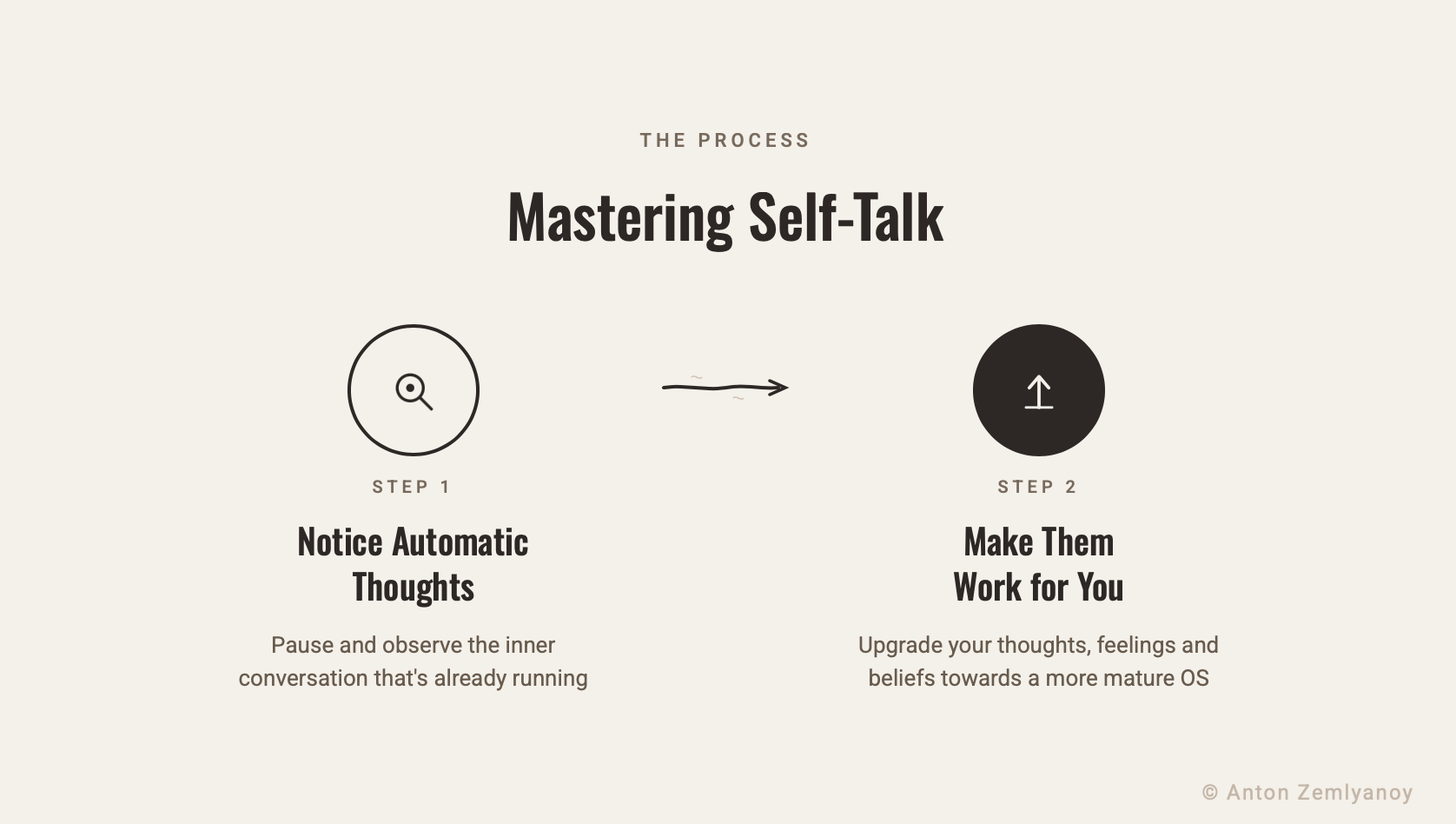
The diagram is from my article Your Internal Operating System Has a Maturity Level — Here’s How to Upgrade It.
Final words
Remember that leadership transitions are complex: they involve letting go of old habits, developing new skills, and upgrading our professional identity, all while wanting to prove your worth to the people who put their trust in you. How much support leaders have during these periods makes a big difference.
Whether you're in the middle of a leadership transition yourself or want to support someone who is — have a look at the Promoted program — it was built exactly for this.
And most of all, be kind to yourself when you feel challenged, just like you would to someone you care about.
Read next
Your Internal Operating System Has a Maturity Level — Here’s How to Upgrade It
Leadership Development for High Achievers: How to Let Go and Still Get Results, Sustainably
27-46% of executive transitions fail — McKinsey&Company, 2018
77% of CHROs lack confidence in their bench strength for critical roles — DDI Global Leadership Forecast, 2025
About the author
Anton Zemlyanoy is an executive coach who helps leaders navigate change with clarity and self-trust, turning self-talk into a leadership strength.
Want to explore this for yourself or your leaders?