
Why Self-Control and Grit Are Determinants of Success
Hint: self-control is about saying yes and no, and grit is about how you keep pushing through
by Anton ZemlyanoyThere are many components at play when it comes to successfully achieving goals. The two that researchers keep identifying as determinants of getting across the finish line are self-control and grit.
Recently, I came across this gem: an intriguing publication¹ by Angela Duckworth and James J. Gross, in which they describe how self-control and grit are correlated but essentially different elements of goal achievement, especially when it comes to long-term and ‘audacious goals’.
What is self-control? And what is grit?
They define:
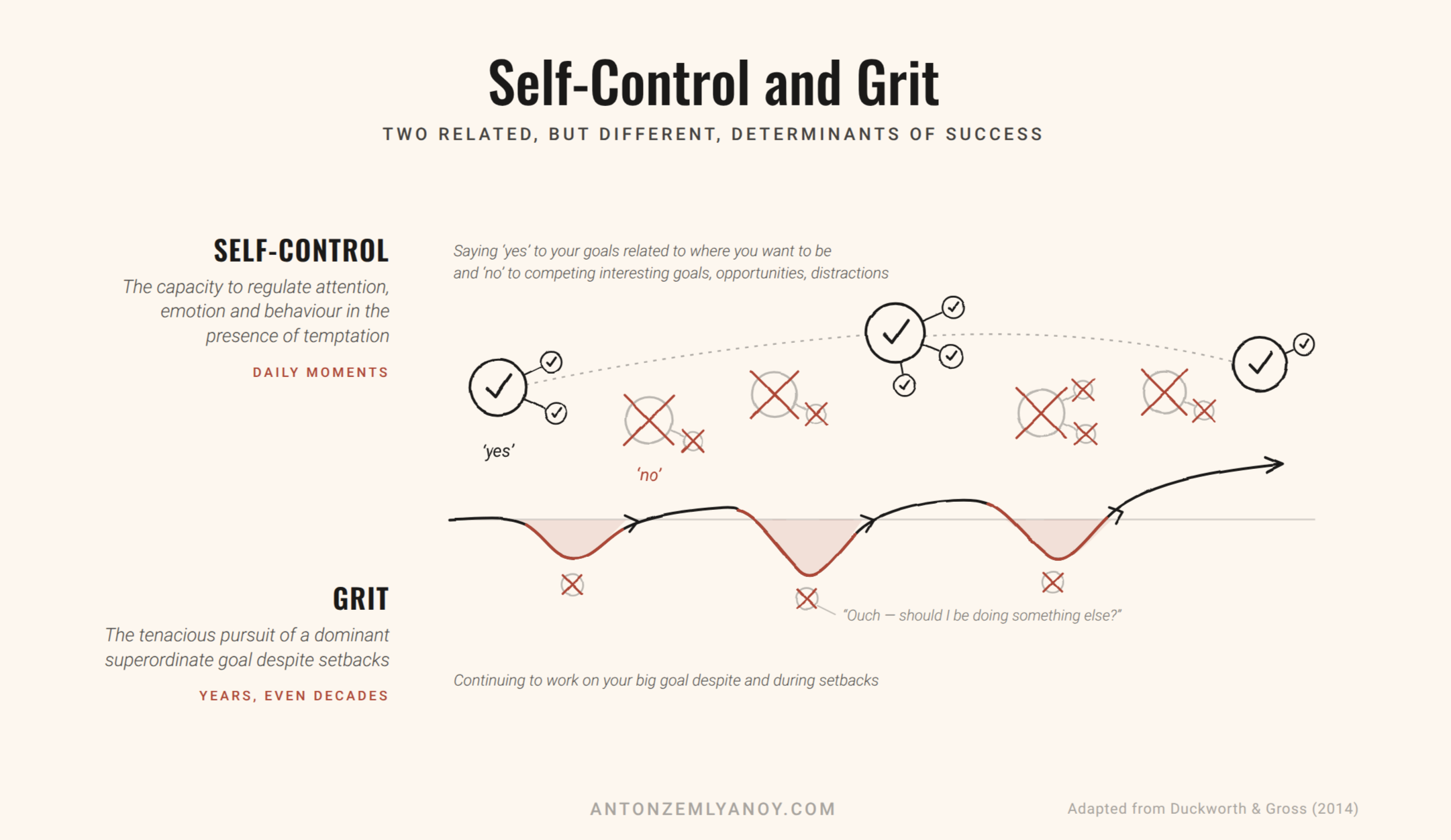
Self-control as the capacity to regulate attention, emotion, and behaviour in the presence of temptation.
And
Grit as the tenacious pursuit of a dominant superordinate goal despite setbacks.
Temptations are not only temporary distractions that can help you deal with your stress, boredom or anxiety (like scrolling through your phone or opening the news once again instead of reaching out to someone who could help you achieve your big goal, for example, a potential client or a colleague). Temptations include other goals or opportunities that seem just as interesting or promising, but which inevitably take up your time, away from your main goal.
I personally said yes to too many projects over the past year, and, having learned the lesson, I’m painfully trimming back to the core essentials, which is why this research paper grabbed my attention, and I’m now writing this article to share with you.
Part of exercising self-control is to continuously keep saying yes to your main goal (and relevant sub-goals), and, even more importantly, to decline all the other goals that appeal to you for whatever reason, but will ultimately compete for your resources, starving your more important and longer-term goal/project/idea of the needed fuel. See my illustration below.
Why grit is an important second element to achieving your long-term goals
Self-control is what you will need to exercise regularly, both during difficult and easy times. Grit is what you will need to remain committed to the work over longer periods and during setbacks.
Ironically, I wrote about grit years ago, without knowing this term existed. This was when I was trying to conceptualise to enthusiastic professionals that things will often not work out the way you planned initially (see my article What to Do When Things Aren’t Working Out) and that you need to develop strategies to help you recover from setbacks and persevere, whether it’s through reframing your self-talk or getting inspiration. Strategies that will help you not give up and keep going, because big, aspiring, ambitious, unique, personal goals often require not only the work, but also the time to get to them. See the illustration from that article below.
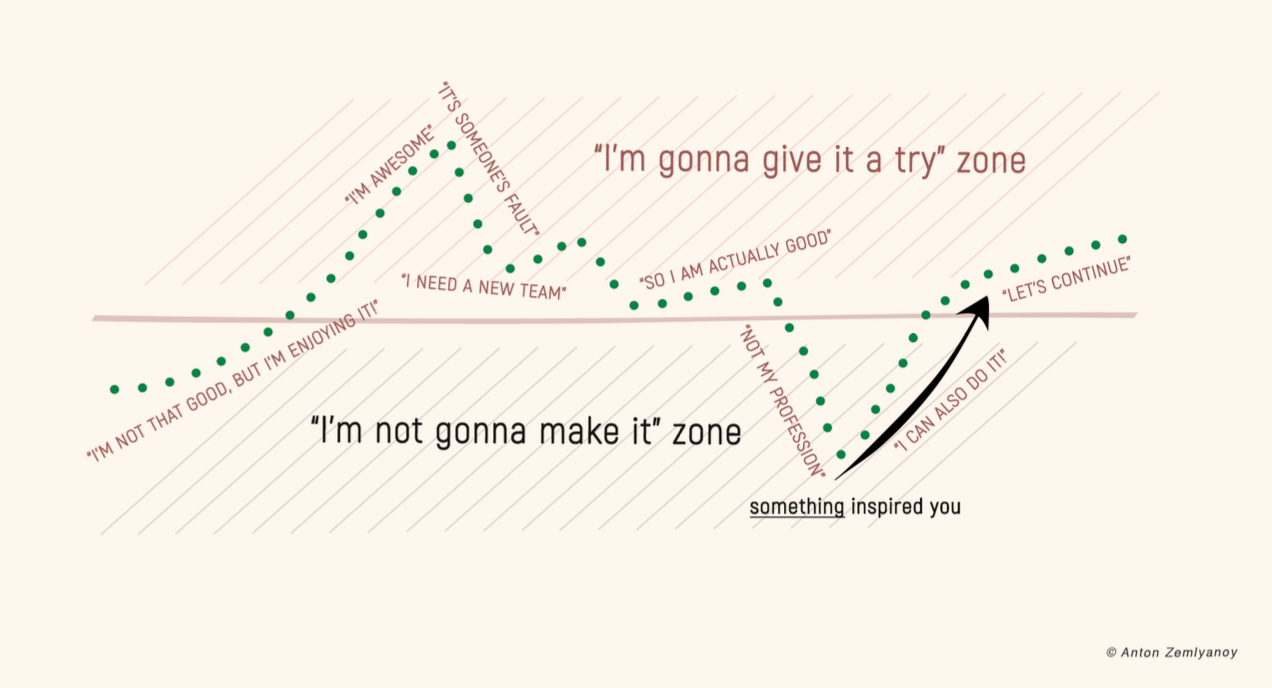
So, grit is about continuing to work on your big goal despite, and especially during, setbacks, and you will need to develop your own strategies that work for your personality. One of my favourite examples is of a celebrated artist Louise Bourgeois, who said in an interview:
“I was not ignored for 13 years. I was left alone to do my work.”
This is an example of a grit-oriented mindset that can help get through the long years of finding, or creating, or building, whatever it is you’re working on.
Another one is of James Dyson: it took him five years and 5,127 prototypes before he invented the first bagless vacuum cleaner.
There are plenty of others.
Time to say no to some competing priorities?
Saying no to goals that seem like opportunities, or emerging interests, can be harder than it sounds. It can be even harder to stop doing them if you already invested in these endeavours. But borrow wisdom from gardeners — they learned that pruning branches is sometimes the only way to save the tree: by trimming some, they give others a chance. I don’t like this idea. I like the practice of it even less. But I also would prefer not to brush my teeth.
Choices and consequences.
You’re always at choice.
Read next
About the author
Anton Zemlyanoy is an executive coach who helps leaders navigate change with clarity and self-trust, turning self-talk into a leadership strength.
Want to explore this for yourself or your leaders?