

Don’t Silence Your Inner Critic
Gather two types of counter-evidence instead
by Anton Zemlyanoy | Self-TalkI don’t believe in actively trying to silence inner critics. An inner critic is an active set of negative beliefs about ourselves, and to suppress anything that’s active in our psyche leads to those beliefs simply moving into the background, into our subconsciousness. Yes, you may hear them less, but if they are running outside our awareness — they will be much harder to detect and will sabotage your success without you even realising why.
It’s like in physics — whenever you push an energy down, it doesn’t just disappear — it must go somewhere.
Better strategies to work with your inner critic
There are several better strategies instead of suppressing your inner critic, and I have tested them all with my clients:
Gather counter-evidence to prove it otherwise
Befriend your inner critic
Develop your inner critic into a mature critical thinking part of your psyche
Reframe whatever perspective your inner critic is attached to
In this article, I cover the first strategy — gathering counter-evidence.
A better strategy: gather counter-evidence
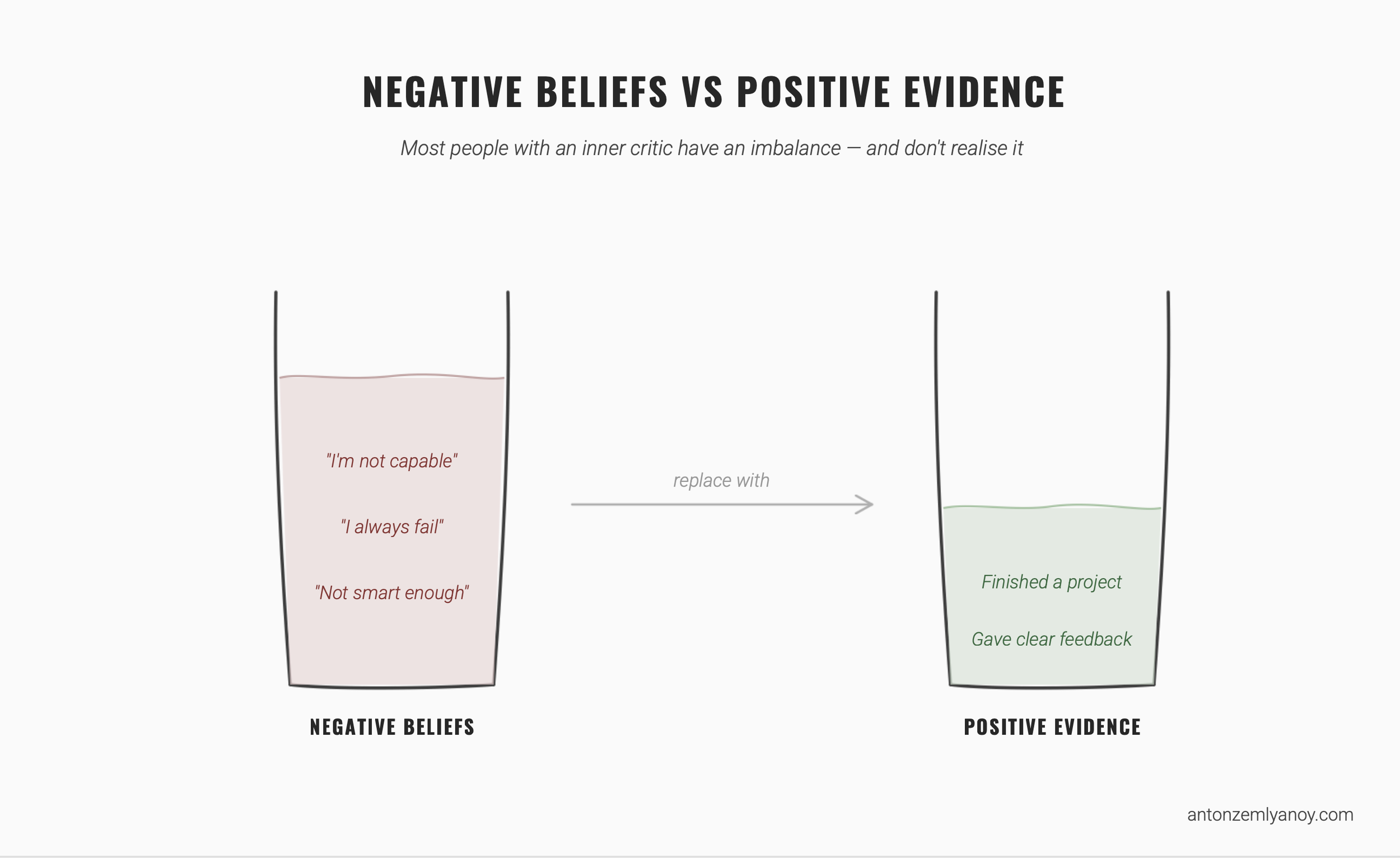
Since an inner critic is a set of outdated negative beliefs we hold about ourselves (e.g. “I’m not capable”, “I’m not worth it”, “I’m not smart”, “I WILL fail”), a better strategy is to gather counter-evidence that proves it otherwise.
For example, if your inner critic says “You never finish what you started, what’s the point?” — the first point of evidence would be to remember what you have finished in the past, or brought to a certain checkpoint. Inner critics often think like children — collapsing a few examples into “you never/always” statements. So if you hear yourself think “I never…” — this is when you need to pause right away and have a talk with yourself.
The second point of evidence would be to break down whatever you’re working on into stages and checkpoints, and then to notice and acknowledge each time you get to that checkpoint. For example, if it’s about sharing your point of view in board meetings, you could start practising it with a simple “I agree”, “I have a question…” or “Great presentation” — this will help you get used to having your voice in the room. Or if it’s getting a difficult team member aligned on a change initiative, you can break it down into having several honest conversations where you can practise being clear, respectful and direct, rather than circling around the topic.
The third point of evidence would be acknowledging not only the results, but also your effort. If you put in the effort, you will get the results, eventually. However, if you rely only on results for confirmation that you’re capable, that gives the inner critic too much fuel to feed on.
One of the clients I’m working with at the time of this writing was needing to have such conversations with three people on her team (the rest of the six team members were all on board). When she didn’t get the result she wanted right away — because the “difficult” person pushed back hard and complained about my client’s leadership — her inner critic started playing the tune of “You’re not made for this role, you’re too sensitive…”
Little did she know at the time, but four weeks later, these initial tough conversations brought results: not only did the relationship with this person become more honest and therefore stronger, but this once “difficult” person was now advocating for my client. What a turnaround that the inner critic simply could not foresee.
In all of the above, if you need to start small — that could be the best strategy. Small early wins will create the foundation of positive evidence that nobody can take away from you, including your inner critic (although it will probably try — it had lots of practice at dismissing the positives and emphasising the negatives).
Other examples where I’ve seen this strategy pay off well:
If you hear yourself think “What’s the point in applying for this role / trying to win a contract — there are people smarter, more capable, more resourced than me?” — the best antidote to this thinking is applying well for that job, getting the job, AND doing well in that job. Easier said than done? Yes and no. It’s harder if you keep believing the pessimistic thoughts. The more positive evidence you gather in each of the above stages, the easier it will become.
“This person on my team is smarter than me — I need to prove it otherwise.” You don’t. Your job as a leader is not to be the smartest person in the room. Your counter-evidence here is every time you hired well, asked the right question, made a call under pressure, or created the conditions for that smart person to do their best work. That’s leadership — and it doesn’t require you to out-know everyone.
“I’m not sure what to do next. Maybe I’m not made for this role.” Not knowing what to do next is not evidence that you’re in the wrong role. It’s evidence that you’re in a new situation. Most CEOs experience imposter thoughts — a Korn Ferry study found that 71% of US CEOs report symptoms of imposter syndrome¹. But here’s the interesting part: 85% of those same CEOs expressed confidence that they are competent in their role. The difference isn’t the absence of doubt — it’s the confidence that they can figure it out. That’s the counter-evidence to collect: not “I always know what to do”, but “I’ve figured it out before, and I will again.”
“Can’t believe I got this role. What if this was all luck and they were wrong for hiring me?” The counter-evidence to luck is specificity. Luck doesn’t explain the specific decisions you made, the specific relationships you built, or the specific problems you solved to get here. When the critic says “luck”, ask it to explain — specifically — which part was luck. It usually can’t.
Once you gather enough evidence that the inner critic believes, it will start becoming quieter by itself. Not suppressed, but naturally quieter — because it will not feel the need to ring the alarm bells.
“What if I gathered all the evidence and the inner critic still doesn’t let go?”
This is the question I received after I posted this strategy on my Instagram. A great question that points to several important aspects:
1. You may need more evidence
If you’ve had layers and layers of negative self-talk over the years, you may need layers and layers of positive evidence — and of a different kind. So if you’re not getting there quickly, if you’re not getting there right away, just be patient because it does take time. Impatience also gives fuel to inner critics.
You need to rebalance how you view yourself and how you talk to yourself. If you had 20 years of negative self-talk, to expect to change this in one week — that’s unreasonable.
2. You may need a different type of evidence
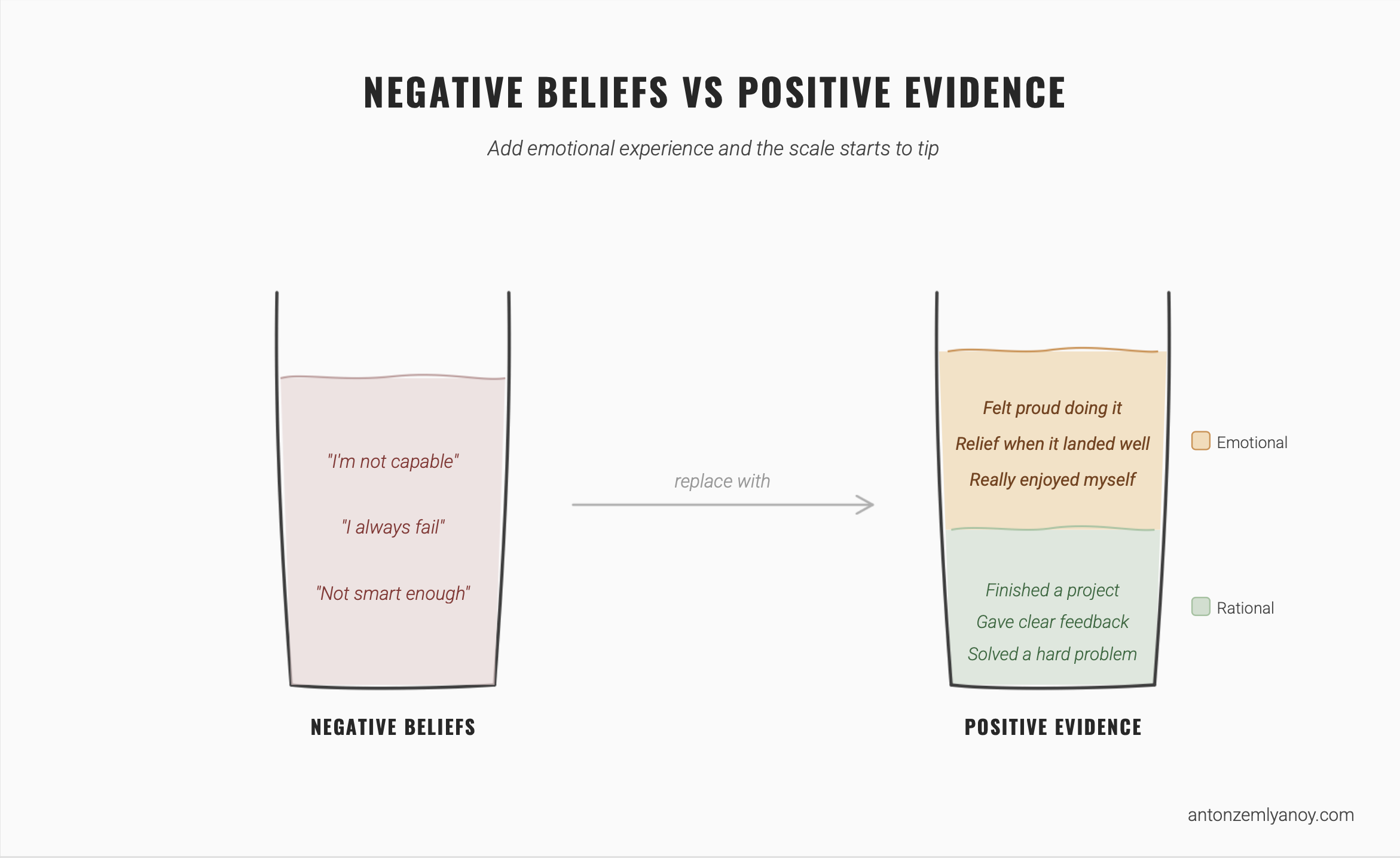
We can have rational, logical evidence: facts and figures. “I’ve done this. I’ve made this many posts. I had this many conversations. I woke up early five times this week.” But inner critics don’t operate on rational evidence. The critic will say, “But you didn’t wake up once!” — “You see, you don’t have this in you.” And it will push away your successes, while focusing on the one thing you didn’t do right, one thing that didn’t work.
Which is why you also need emotionally-rich evidence. And you do this by allowing yourself to go into the emotional experience of doing whatever you set out to do. Whenever you wake up on time, or have that tough conversation where you practised being direct and respectful, or you made a genuine compliment, whenever you applied for that contract or role, whenever you shared your point of view with the CEO or your board — it’s important to slow down and feel the emotions of carrying through with your plan.
Feel what it’s like to be proud. I once got goosebumps when I did something I was proud of — I spoke out with a strong opinion against an organisational decision. So I slowed down, allowed myself to feel both the tension first, but also the relaxation and celebration as I trusted myself to do what felt right. And I still have that emotional memory in my body.
What’s it like when you do something that was hard for you?
Create a space where the emotional experiences also get accumulated, because that’s rich complementary evidence to the rational data you will gather.
3. A negative environment will make it harder
If your environment is negative — that will also make it harder. For example, if you are trying to be less hard on yourself, but then you’ve got somebody next to you — a boss, a colleague, or a partner — who keeps pointing at your flaws, or what you haven’t done well. In short, if they keep criticising you instead of offering constructive critique of your work — that gives extra fuel to the inner critic:
“I was right. They were right. Your boss is right. You were wrong for trying — I told you so.”
If you have that in your environment, just please know that this will be harder for you and you need to create pockets where a positive relationship with yourself is available, because you will absorb it over time.
The trap of proving your inner critic wrong (for too long)
And lastly, there are plenty of successful people who are high achievers — CEOs, managers, lawyers, sports players, artists, professors with multiple PhDs — who have active inner critics telling them that they need to keep proving themselves through achievement. They get trapped in this “I will prove to myself that I’m worthy” loop.
This is not the strategy I’m suggesting here. Not to prove anything if you have an archaic unreasonable belief stuck from your childhood that says “You’re only worthy if you achieve, or look a certain way, or live in a certain house”.
But to gather evidence because you have a vision, a desire to create something, a desire to do something good, while the inner critic says “Who do you think you are to do this?”
If your critic doesn’t become quiet despite the evidence, notice the game running inside of you. Flip it around. Change the game to getting your inner critic to prove that it loves you — even without your achievements.
Now that will be an interesting game to play.
If you need help with this — especially initially — get help. It’s one of the bravest things you can do.
Read next
Footnotes
Korn Ferry, Workforce 2024 Global Insights Report (June 2024). The study found that 71% of US CEOs experience symptoms of imposter syndrome, while 85% expressed confidence in their competence
The Imperfects podcast — “Psychology Summer — Your Inner Fan with Dr Emily” (January 2026). Dr Emily Musgrove discusses top-down vs bottom-up therapeutic approaches to working with inner critics and self-compassion.
About the author
Anton Zemlyanoy is an executive coach who helps leaders navigate change with clarity and self-trust, turning self-talk into a leadership strength.
Want to explore this for yourself or your leaders?